
Reroofing & Capital Roof Replacement
A roof replacement is a capital project, not a purchase.
It gets budgeted a year or two out, it has to survive an ownership or board approval, and it has to happen without shutting the building down. We start with an assessment and a budget number you can defend — and we do not quote a replacement on a roof that does not need one yet.
Before you replace anything
The assessment comes first, and it is allowed to conclude “not yet”
Plenty of commercial roofs get torn off with eight good years left in them, because the only person who inspected it was the person selling the replacement. That is a conflict of interest, and we handle it by writing down the remaining service life before we write down a price.
If the roof qualifies for a restoration or a targeted section replacement, you will see that option priced next to full replacement, with the honest expected life of each. Sometimes deferring three years is the right financial answer. Sometimes it is not, and we will show you why.
What drives the number
- Square footage, roof height, and access for material handling
- Tear-off versus recover, and how many layers are already up there
- Deck type, and how much of it has deteriorated
- Energy code R-value requirements triggered at replacement
- Wind uplift design and the resulting attachment method
- Drainage corrections and tapered insulation
- Rooftop equipment that has to be raised, recurbed, or reset
- Warranty term, and whether it is labour-inclusive
Assessment to closeout
The process, from the first walk to the executed warranty
Roof condition assessment
A full walk with photographs, core cuts where warranted, a moisture survey, drainage evaluation, and deck condition. The output is a written report with estimated remaining service life — not a proposal.
A budget number you can put in a capital plan
Before there is a specification, you get an order-of-magnitude cost with the assumptions stated. That is what a board, an owner, or a superintendent needs in order to get the money approved in the first place.
System selection & specification
Assembly, attachment method, insulation and R-value, wind uplift design, drainage corrections, and warranty term — chosen for the building and its exposure, then documented so every bidder is pricing the same roof.
Manufacturer approval & submittals
Product data, assembly approval, wind uplift calculations, and the manufacturer pre-installation requirements handled before mobilization, because that is what makes the warranty enforceable later.
Construction around an occupied building
Phasing, daily tie-ins so no area is ever left open overnight, protected access routes, debris and odour control, and scheduling against the building actual operating hours — or its summer break.
Inspection, closeout & warranty package
Manufacturer field inspection, punch list, and a closeout package with the executed warranty, as-built assembly, maintenance requirements, and the photographs. Then the roof goes onto a maintenance schedule.
Systems we install
Low-slope, metal, and restoration assemblies
The right system depends on the building — its deck, its exposure, its rooftop equipment, what happens inside it, and how long the owner intends to hold it. We are approved with multiple manufacturers specifically so the assembly can be chosen for the building instead of for our supply agreement.
TPO — thermoplastic polyolefin
Heat-welded seams, high solar reflectance, and the most commonly specified low-slope system on commercial buildings today. Mechanically attached, adhered, or ballasted depending on wind uplift requirements and deck type.
EPDM — rubber membrane
A long field record on commercial roofs, strong hail and weathering resistance, and simple detailing. Black or white; mechanically attached, adhered, or ballasted.
PVC — polyvinyl chloride
Chemical and grease resistance that makes it the right choice around restaurant and food-processing exhaust, where a standard membrane degrades quickly.
Modified bitumen
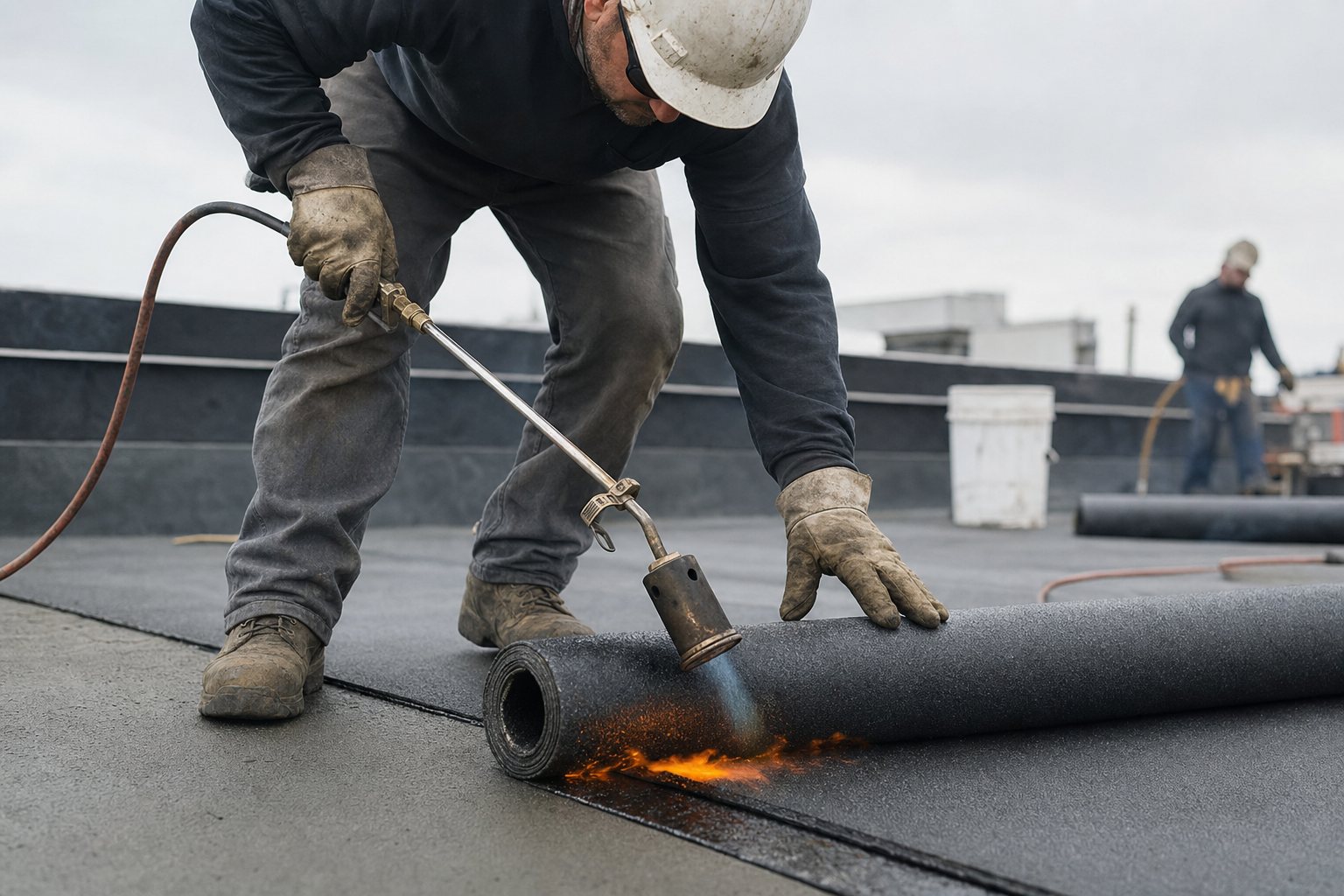
Multi-ply asphaltic systems — torch, cold-adhesive, or self-adhered. Redundant plies make it durable on roofs with heavy foot traffic and frequent service access.
Built-up roofing
Traditional multi-ply felt and asphalt assemblies with a surfacing layer, still the right repair-in-kind answer on many older institutional buildings.
Metal — standing seam & retrofit
New standing seam, plus retrofit framing systems that build slope over an existing failing flat roof to solve chronic ponding rather than repeat it.
Roof coatings & restoration
Silicone and acrylic restoration systems over a sound existing roof. Where the substrate qualifies, a restoration can extend service life for a fraction of a tear-off and carry its own renewable manufacturer warranty.
Insulation & cover boards
Polyiso, tapered systems to correct drainage, and cover boards to protect the membrane. Energy code often requires an R-value upgrade at replacement, which has to be priced into the capital number up front.
Warranty
A manufacturer warranty is only worth what the installation supports
Warranty coverage on a commercial roof depends on three things: the installer being approved by that manufacturer, the assembly being installed exactly as the approval requires, and the roof being maintained afterward. Miss any one of them and the certificate in your file will not pay for the repair.
Material-only
Covers the membrane and components if they fail. Does not cover the labour to find or fix the failure, and does not cover workmanship. The cheapest certificate, and the one most often marketed as a “20-year warranty”.
System / total system
Covers material and the manufacturer-approved installation as an assembly, typically following a manufacturer field inspection at closeout. Requires an approved installer.
NDL — no dollar limit
The manufacturer obligation to repair is not capped at the original contract value. The strongest coverage available, with the strictest installation and maintenance requirements attached.


One contract, the whole scope
Roof replacements rarely stay a roofing-only project
Once the roof is open, rooftop units need to be lifted or recurbed, conduit and gas lines need re-supporting, drains and overflow piping get replaced, lightning protection and rooftop electrical get reterminated, and interior ceilings and finishes need repair. Badger holds one contract across all of it, so the trades get scheduled against each other instead of blaming each other.
Need a roof number for next year budget?
A condition assessment and an order-of-magnitude cost is the cheapest thing we do, and it is what gets a capital project approved. Send the address and the approximate square footage.