
Commercial Roof Service & Repair
A roof leak is a diagnosis problem before it is a repair problem.
Plenty of commercial roofs get replaced with years of service life still in them, because nobody could tell the owner where the water was actually coming in. We find the source, document it, and price the repair alongside the replacement so you can see the difference for yourself.
Active leak on an occupied building
Stop the water first. Diagnose second. Sell nothing until it is documented.
When a roof is leaking into a tenant space, a server room, a classroom, or a production floor, the first job is protecting what is underneath it. We dry the building in, then come back and do the diagnosis properly instead of guessing under pressure.
What our 24/7 emergency response actually means
It means a phone number that reaches Jeffrey Speers and a crew that can mobilize to protect the building. It does not mean a permanent roof repair gets made correctly in the rain at 2:00am — nobody can promise that honestly. We dry it in, we photograph the conditions, and we schedule the real repair.
How we find the source
Leak diagnosis, in the order that actually works
Start where the water shows up
Interior stain location, ceiling grid, deck type, and insulation condition tell us how far the water has travelled. Water rarely enters directly above the stain, which is why chasing the stain alone is how repairs get missed.
Walk and map the roof
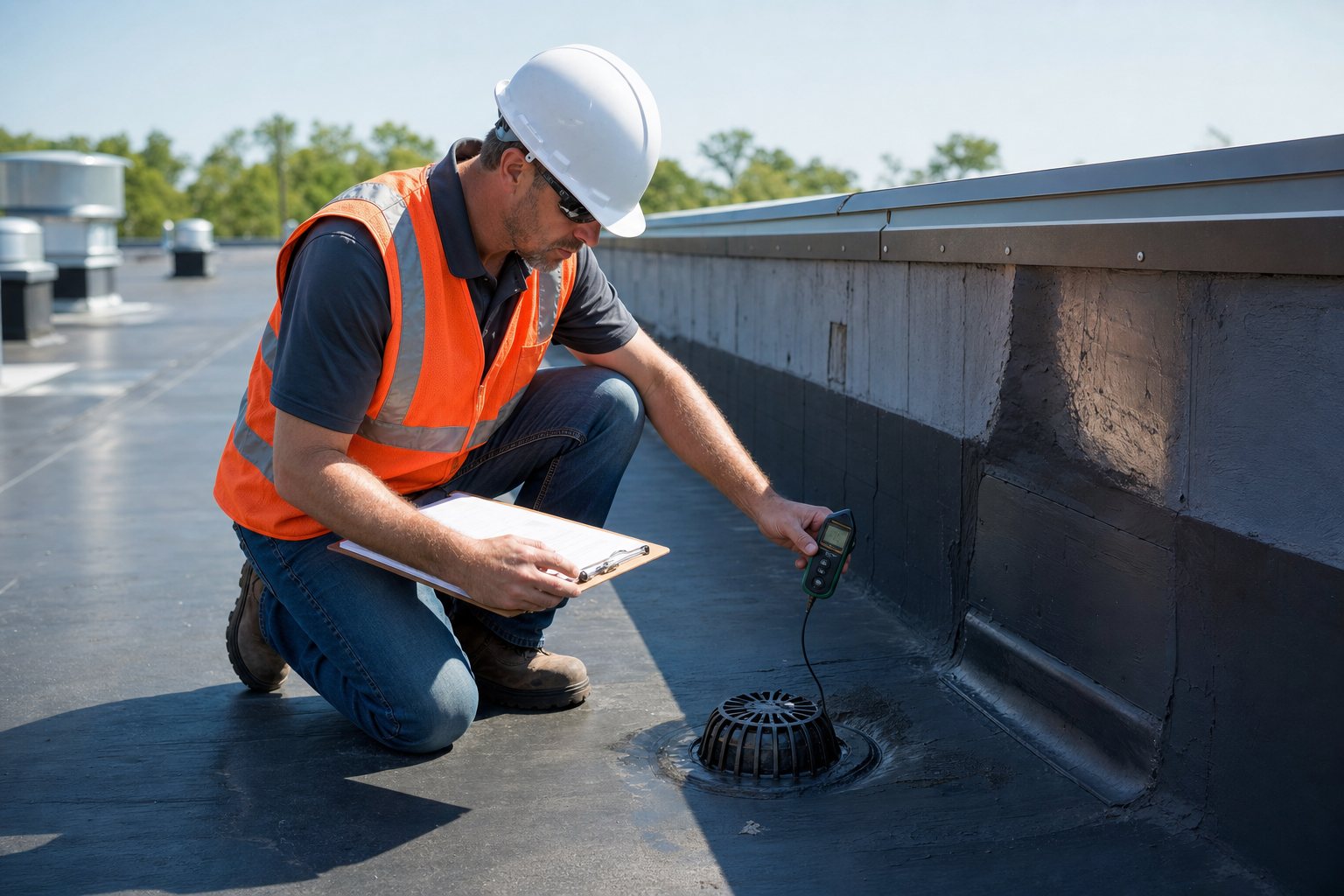
Field membrane, every penetration, every termination, every transition. Each defect gets a photograph, a location on a roof plan, and a note on whether it is the likely source, a contributing defect, or a future problem.
Look for trapped moisture
Wet insulation does not dry out on its own — it keeps rotting the deck and destroying R-value long after the surface leak is patched. Moisture surveys and core cuts establish how far the wet area extends so the repair removes all of it.
Deliver a written report before a price
Photographs, the cause, the extent, and the options. Repair, section replacement, restoration, or full replacement — each with a number and an honest expected service life, so you can decide instead of being sold.
What we repair
Repairs across every low-slope and metal assembly we install
We repair the roof you have, using materials compatible with it — including roofs originally installed by someone else. The wrong sealant or an incompatible membrane on a warranted roof can void the warranty, so compatibility gets checked before anything is opened up.
Membrane leaks & seam failures
Open or fishmouthed seams, punctures, shrinkage at the perimeter, and split laps on single-ply and modified bitumen roofs. Repaired with materials compatible with the existing assembly so the warranty is not voided.
Flashing & termination details
Base flashing, counterflashing, coping, reglets, expansion joints, and wall terminations. Most “roof leaks” are actually detail failures at a transition rather than a failure of the field membrane.
Penetrations & curbs
Pipe boots, vent stacks, conduit, gas lines, equipment curbs, and pitch pockets. New rooftop equipment set by other trades is one of the most common sources of a brand-new leak on an otherwise sound roof.
Drains, scuppers & ponding
Clogged and undersized drains, failed drain bowls and clamping rings, blocked scuppers and overflow provisions, and standing water that is overloading the deck and shortening the life of the membrane.
Skylights, hatches & curbs
Cracked lenses, failed gasketing, corroded frames, and roof hatches that no longer seal — plus fall-protection screens and guarding where required for safe access.
Metal roof repair
Backed-out and stripped fasteners, failed closures, panel end laps, ridge and eave details, wind-lifted panels, and rusted-through sections on standing seam and R-panel roofs.
Storm & wind damage
Hail bruising, wind uplift, displaced ballast and edge metal, and impact punctures — documented with dated photographs, test squares, and a written condition report suitable for an insurance file.
Emergency dry-in
Temporary patching, tarping, and water diversion to stop active water entry into an occupied building, then a permanent repair scheduled once the building is protected.
The documentation you keep
Every service call ends with a paper trail, not a verbal summary
Facility managers get asked to justify spending. Building owners get asked by insurers, lenders, and buyers what has been done to the roof. A verbal “we patched it” is worth nothing in either conversation.
- Dated photographs of each defect, before and after
- Defect locations marked on a roof plan
- Written cause of the leak, not just its location
- Materials used, so the next contractor knows what is up there
- Remaining concerns with a recommended timeline for each
- Repair-versus-replace comparison, with both numbers
Why we lead with repair
Storm-chasing outfits appear after hail, sell full replacements on roofs that need flashing work, collect the insurance proceeds, and leave the state. We are based in Seminole and expect to be maintaining your roof in ten years. That only works if we tell you the truth the first time.
When we will tell you to replace it
Saturated insulation across a large share of the field, a deteriorated or corroded deck, a membrane at the end of its service life, or a roof already carrying multiple layers. In those cases repairs are money spent twice, and we will say so in writing.
Beyond the roof
The same service call can cover the mechanicals and the grounds
Badger is a general contractor, not only a roofer. When a rooftop unit turns out to be the actual source of the water, or the leak has damaged a panel, a ceiling, or a drain line, the electrical, HVAC, and plumbing divisions handle it under the same contract rather than sending you to find three more contractors.





Have an active leak, or a roof nobody has looked at in years?
Send the address, and a photo of the interior damage if you have one. You will get a documented condition report and a real number — including the option of not replacing the roof.